Monetization Strategies for Food Bloggers
What if you stopped chasing every platform and committed fully to one that actually builds trust, authority, and income? In this episode, Maria Lucey shares exactly how she grew a YouTube channel to nearly 50,000 subscribers in just over two years, monetized early, built a massive email list, and replaced her full time clinical job without relying on SEO or social media trends. This conversation breaks down what really works on YouTube for food creators and why consistency beats perfection every time.
Listen on the player in this post or on Apple Podcasts, Spotify, YouTube or your favorite podcast player. Or scroll down to read a full transcript.
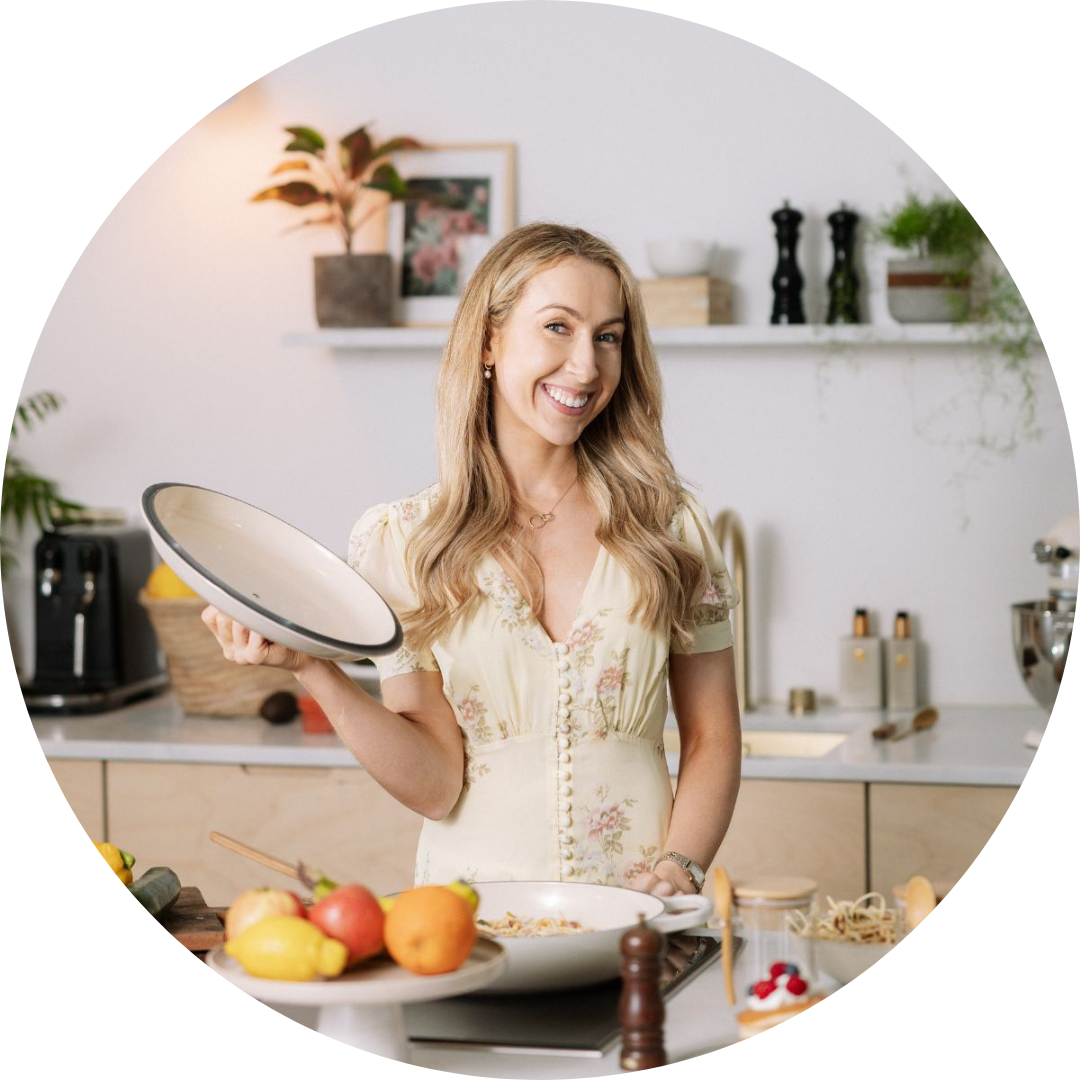
Maria Lucey is a Registered Dietitian and content creator who launched her YouTube channel at the end of 2023 and grew it to over 44,000 subscribers in just over two years. Her channel focuses on long-form nutrition education and practical recipes that help people meet their health goals.
Although she didn’t have a blog when she started YouTube, Maria quickly recognized how the two platforms could complement each other and began building her blog soon after. Today, YouTube is her second-largest traffic source after Google and has helped her grow an email list of more than 6,000 subscribers, primarily through YouTube opt-ins, despite her blog still being relatively small.
She monetizes through brand partnerships, YouTube and Mediavine ad revenue, and digital products. Maria is passionate about showing that anyone can start from zero — she began with no SEO or camera experience and built her platform through consistency and learning along the way. She also emphasizes how well blogging skills transfer to YouTube, and recently was flown to Los Angeles to collaborate with some of the platform’s most established creators.
Takeaways
- Future Consistency beats talent every time: Posting one video per week built momentum, skill, and confidence long before results showed up.
- YouTube rewards commitment not volume: Growth came from showing up weekly, not from posting more often or gaming the algorithm.
- Your first videos will be bad and that is the point: Improvement only happens through repetition and publishing before you feel ready.
- Monetization can happen faster than you think: Maria reached YouTube monetization within six months by focusing on watch time and value.
- Email lists convert extremely well from YouTube: Simple lead magnets tied directly to video topics drove consistent list growth.
- Packaging matters as much as content: Titles and thumbnails determine whether your video gets clicked at all.
- Curiosity outperforms keywords early on: Intrigue driven titles helped videos get discovered before shifting to SEO later.
Resources Mentioned
Get Megan’s Memoir – Take the Exit – Step inside the story!
Maria’s YouTube Equipment
Transcript
Click for full script.
EBT787 – Maria Lucey
[00:00:00] Megan Porta
What if you could start from zero and build a thriving platform through YouTube alone? That is exactly what Maria Lucy did. In just over two years, she grew her channel to nearly 50,000 subscribers. She built an engaged email list, launched multiple revenue streams, and she even left her full time job, all starting without SEO or camera experience.
[00:00:24]
In this episode, Maria shares her honest journey, the strategies that helped her grow, and how food bloggers, yes, even small ones, or if you haven’t even started your channel yet, can use YouTube to drive traffic, build authority, and create new income streams. This is the roadmap we wish we had sooner.
[00:00:44]
Hi food bloggers, I’m Megan Porta and this is Eat Blog Talk.Your space for support, inspiration and strategies to grow your blog and your freedom. Whether that’s personal, professional or financial, you are not alone on this journey.
[00:00:58] Megan Porta
Maria, hello. How are you today from Bermuda? Oh my gosh.
[00:01:02] Maria Lucey
Hi, Megan. I’m good. I’m very excited to be here.
[00:01:04] Megan Porta
I wish I was maybe switching places with you. You can come to Minnesota and I will gladly sit in Bermuda for the day.
[00:01:13] Maria Lucey
Yeah, I must say we’re quite lucky. It’s quite a nice day today.
[00:01:17] Megan Porta
What’s the temp today?
[00:01:20] Maria Lucey
So I usually do it in degrees, so we’re probably like 25 degrees, which is like a nice summer day.
[00:01:26] Megan Porta
Yeah. And that’s Celsius, so I don’t know what that. Yeah, that sounds perfect. Fahrenheit. It would probably be perfection. Yeah, amazing. Well, thank you for joining. We are going to talk about YouTube today, a hot topic for 2026. Everyone, not everyone, but a lot of people are veering off toward video, which I think is a super smart move in this landscape.
[00:01:47]
So thank you for being our YouTube expert today. We appreciate your time to start. I wanted to ask you what is the pain point that you think will deliver people to this episode?
[00:02:02] Maria Lucey
And listen, I think a lot of people in the food blogging space would like to start a YouTube channel, or maybe they have already started, but they’re not really seeing growth. So what I really want to chat through in this episode is to make people feel less intimidated by it because I think as a long form platform, people are almost a little bit scared to start or feel like they don’t know where to start.
[00:02:29]
And then also once you do and if you are tips to really help you grow, because like any platform, there is a little bit of a strategy behind it. So hopefully that’s what I’ll be able to provide some insight into.
[00:02:41] Megan Porta
Yeah, amazing. I think you’re. You nailed it right on. It feels overwhelming. It feels like you need to have a huge setup, you need to have professional production right off the bat. You need all kinds of editing skills and you know, there’s all this stuff that I think is a hang up for people.So hopefully we can break that down a little bit today.
[00:03:01] Maria Lucey
Yeah.
[00:03:02] Megan Porta
So to start, Maria, can you give us a background on your blog and then also weave in your YouTube channel? Like how everything has evolved for you?
[00:03:12] Maria Lucey
Yeah. So my blog is Maria Lucey Dietitian. And the name isn’t a giveaway as it is. It’s about healthy recipes and I also have a mix of nutrition articles as well. So it’s kind of teaching people how to eat healthier. Maybe it’s like the principles of like an anti-inflammatory diet, for example.
[00:03:33]
And then I have recipes that like correspond with that. And my message is I always want healthy eating to seem practical, simple and a lot less complicated than it is made to be online. So the blog is quite young, I suppose you would say. So I started my YouTube channel at the end of 2023 and I had no idea about blogging and I stumbled across a YouTuber talking about blogging and then realized that, oh, there is a whole other like avenue here that I did not know anything about.
[00:04:06]
And I figured that everything I was doing on YouTube was very complimentary to the blog and that they could work really, really well together. And basically all of my YouTube scripts could be repurposed into blog posts and blog posts could be made into videos and that they really like went side by side, especially in the food and health kind of area.
[00:04:29]
So I started the food blog then around the start of 2024, but it’s only really like the last year and this year that I’m able to focus more time on it because I was up until recently, which I’m sure we’ll get to thanks to YouTube, able to quit my full time clinical role.
[00:04:47]
Yeah, so now they kind of, they work side by side and I suppose they help build an ecosystem. So you could say YouTube is the main hub or you could say the blog is the main hub, but they both attract an audience. And I suppose it helps if you think of your blog or your YouTube channel as a business.
[00:05:11]
It helps just kind of build different branches out of that business and helps you diversify in terms of income streams, in terms of building a loyal audience. It’s like a network. Yeah, I suppose, for sure.
[00:05:26] Megan Porta
Yeah. And we can talk a little bit more about that. And I was just going to point out that your YouTube channel, you started at the end of 2023, so just over two years and you’ve already gained, it’s almost 50,000 subscribers. So for anyone listening who’s like, it takes forever, it’s going to be slow.
[00:05:45]
This is such a great, inspiring story. I mean, that’s incredible. So let’s talk about how you did that. I mean, that those numbers speak for themselves. What do you think your. Well, let’s just talk about your YouTube journey. Where did you start with that and how has that evolved?
[00:06:05] Maria Lucey
So I think when I was thinking about starting a YouTube channel, I really took some time to. Well, I’ve always been a lover of YouTube, so I would have spent a lot of time on the platform. But I really did some research like into other people on YouTube who was doing well. And you could, you could argue that YouTube is extremely saturated in terms of food, in terms of nutrition and health advice.
[00:06:30]
But I really felt like there was actually a gap for somebody that wasn’t like preaching extremes for somebody who was a registered dietitian. And, and at that, when I thought that there was potential there, I spent, I did spend a lot of time before I ever published my first video working on how I was going to position myself in the direction that I wanted to start my channel.
[00:06:55]
So it wasn’t like I just decided one Saturday and the next Saturday I started. I took a lot of time to plan it out. And it was also a period of time where I think still reflects today in that a lot of other food creators and a lot of other dietitians were focusing their energy on Instagram or short form content.
[00:07:14]
And I wasn’t sure, like YouTube is a different route to go down. And I was working full time as well. So like I had to really, really commit to which route that I want to go all in and put my effort into. And I decided on YouTube because I felt people were not doing it.
[00:07:35]
Everybody else was doing the short form content and I just felt like if I really committed, it might pay off. And thankfully it did. But I suppose to answer your question about growing, I posted one video every single week for the bones of two years. Like up until now I think I’ve only ever missed the odd few uploads and I had very good excuse, like I got married or something.
[00:08:04]
So I think if you are going to do YouTube and take it seriously, you do need to be showing up consistently. And it’s not. A lot of people think that when they hear, oh, you need to post consistently, it’s to do with the algorithm and that the algorithm will get to know you.
[00:08:22]
And that’s why that’s how you will grow. And of course things like that help, but YouTube’s algorithm tends to perform quite differently to something like Instagram. So you don’t really get rewarded by posting more. But why it is important to post every week is that you do need to build up that momentum and you do need to, you do need to practice.
[00:08:44]
It’s like if you were to, this is such a dietitian example now. But if you were to go to the gym and start working at your biceps, it’s going to take weeks to months for those biceps to finally start to grow. But you need to keep putting in those consistent reps. And it’s the exact same thing with YouTube.
[00:09:01]
So if you go onto my channel, you can like filter and watch my oldest ever video, because I’ve never deleted a video. Like, it’s absolutely awful. But you just have to do one and then get a little bit better every single time.
[00:09:18] Megan Porta
Yeah, I think that’s the case. Like what your example was with so many things, you just, you have to put in the work in order to see the payoff. So YouTube is no exception. So how long did it take you to get monetized on YouTube?
[00:09:35] Maria Lucey
It took me about three to six months, I think. I think I got 1,000 subscribers. So to get monetized on YouTube, you need 1,000 subscribers and 4,000 watch hours. So I got the 1,000 subscribers in about two to three months. But then it’s the watch hours that tends to be a little bit harder.It takes a little bit more time. So that just took me another month or two. Okay, so within six months I was monetized.
[00:10:03] Megan Porta
That’s great. I think that’s on the short end of what people typically see. Do you feel like seeing traction on YouTube is niche dependent because your niche lends for like, curiosity, I think, just like, how do I eat healthier, especially this time of year. But what if it’s a niche that’s more general or like mine is cozy comfort food, easy recipes.
[00:10:26]
Do you think that you can gain more traction more quickly if it’s a smaller niche or a more niched down category?
[00:10:35] Maria Lucey
I think it can probably help if you are more niche down. That said, like, when you look at nutrition, you could. It’s also quite a saturated market. So it’s, it’s trying to find a way for you to stand out and be a little bit more different almost and to get attention in a way that not everybody else is doing almost.
[00:11:03] Megan Porta
Yeah.
[00:11:04] Maria Lucey
So like a big something I’ve learned with YouTube is spending. So at the start, the first year on YouTube, all I focused on was just making a video every single week. I wasn’t too worried about my titles or my thumbnails. I was just trying to build a system and get into the groove where.
[00:11:21]
Whereas once you go from that stage to kind of trying to grow that little bit more, you have to get more strategic. So I could have 10 different videos that I want to make next week, but I have to really think which video is actually going to be a needle mover and which video is going to get the most interest and has the highest potential for views.
[00:11:44]
So that’s when you really have to just get a little bit more thoughtful. You’re not just throwing spaghetti at the wall to see what sticks anymore.
[00:11:52] Megan Porta
And that’s similar to what we experience with Google and Pinterest. Right. You just experiment a little bit and then you find an avenue and you kind of run with that instead of just wildly picking whatever. You don’t just create a video about any topic under the sun. You have to be a little bit intentional.
[00:12:11]
And then outside of. Because I know YouTube provides revenue once you reach that monetization status. Right. Do you make money any other way through YouTube?
[00:12:22] Maria Lucey
Yeah. So, yeah, the, the money that you make from YouTube itself is. Now for me, it is a nice amount, but at the start it’s very little. But it has really helped diversify my income into different streams. So for example, my blog, um, my blog is new, quite small, but a lot of my traffic is direct.
[00:12:46]
Um, and then I also have referral traffic from YouTube itself. But when you build the personal brand through YouTube, you can go in other directions. So I have built a really large email list because from the very start, in most of my videos I had like a freebie based on the topic, or I had a free recipe ebook that I would call out at the end of every single video.
[00:13:10]
So I was able to grow a very large email list off of that. And as you know, like an email list is really valuable. So I now have digital products that I sell and I also have like my own services so you can market those to people. But a big driver of revenue for me has been working with brands, particularly in the last year, once you get to a significant size and you built that audience and that can be, that can be a big way of making revenue from YouTube.
[00:13:46] Megan Porta
And does that work similarly to just working with brands on a blog? So you do reach out or they reach out to you and you just come up with a contract based on your needs and their needs and deliver one video or something. Like how does that usually work?
[00:14:05] Maria Lucey
Yeah, so I’ve never actually worked with a brand on my blog. All of my brand deals have been through YouTube and they’ve been through YouTube videos. So kind of more in recent months. What I’m seeing is that rather than just doing one video, you’re trying to. Brands want you to do like a package of videos.
[00:14:25]
So maybe one video a month for four months kind of. But yeah, it’s definitely because I have a presence on Instagram as well. But when it comes to brand deals, it seems to be. I find that YouTube is the biggest appeal for the brands because when you think about it, if you have an ad in a long form YouTube video, people are sitting down and they’re watching that video for like 10, 15 minutes and they’re, they’re.
[00:14:55]
The ad almost has, I suppose, more value because people are more engaged rather than something that they see in short form. Sorry, I take off my Apple watch.
[00:15:06] Megan Porta
Oh, you’re good. Yeah, that makes sense. So at what point do you think there’s kind of a number that you have to reach on YouTube in order to get those good brand deals or not?
[00:15:21] Maria Lucey
I think like I definitely started to see, I definitely started to get more consistent brand deals after around 10,000 subscribers. But I don’t think that, I don’t think there is a number. I think it can differ. Like if you have a very engaged audience and you’re getting loads of views on all of your videos, then you have leverage to pitch to a brand.
[00:15:41] Megan Porta
Okay. Yeah, that’s kind of the same with Instagram. Right? Like it used to be that it was kind of 10,000 and now people are saying you, you don’t have to be anywhere close to that. So it sounds the same. I have a question for you. Okay. I’m just getting into YouTube after basically ignoring my YouTube channel for like six years.
[00:16:02]
So, uh, forgive me for throwing all kinds of questions at you, but I’m so excited to learn from you. I’m working on retention because I know that’s huge, especially for trying to get the watch time. Um, do you have any tricks for just getting people to sit through like a 10 minute video or more?
[00:16:22] Maria Lucey
Um, I would. Well, you, first you want to make sure that your hook is really engaging, that they, that they stay for at least the first 30 seconds. After that, I think you don’t want the video to be longer than it needs to be. You don’t want to be filling it with fluff.
[00:16:41]
You don’t want to be making people sit there if they don’t need to. You want to be delivering value. Now that doesn’t mean you need to be rambling at your points really quickly. But there are different things then that you can do to help with retention. So for example, at the start of one of my videos, what I might say is there are seven points that we’re going to cover today, but point number five is really going to change your life.
[00:17:08]
And then they’re going to be like, intrigued. Of course they could skip to point number five if they wanted to, but you’re kind of alluding to something exciting that’s going to happen later on in the video. Other things, I suppose you just want to, you want your editing to be tight. Now I do think the good thing about being a food blogger or a food creator is that you don’t have to have highly edited videos like other niches like in entertainment.
[00:17:36]
I think if anything, that can almost ruin us a little bit for people. But you do want things to be smooth so that somebody can watch it through.
[00:17:46] Megan Porta
Okay. And kind of fast, faster paced. Right. Like people. I feel like people’s attention span is shrinking. So just things to keep people engaged throughout, I’m assuming.
[00:17:58] Maria Lucey
Yeah. And even you could, instead of always being talking to the camera, you could be doing the visuals and doing voiceovers in different parts that might help move things along. Other things that help, you don’t have to make it too complicated, but just changing up your angles, that can be useful as well.
[00:18:19]
What I will say is like, compared to making a short form piece of content that tends to need to be extremely snappy. Whereas on YouTube you can slow down that little bit more. But again, you just want to make sure that you’re not like people do have shorter attention spans now.
[00:18:37] Megan Porta
Right. Yeah, I feel like it’s a balance. But going back to that experimentation piece and just putting content out, you have to publish regularly and then learning from that right as you go.
[00:18:49] Maria Lucey
And I will say that like even some of the best YouTubers, their retention span, the average on YouTube, it’s still like you’re doing really well if you get to like 30%. Oh yeah. So like most of mine, I would, I’d aim for like, I’d always have over 30% but like it would be very unusual to see like a 70, 80% retention on a YouTube video. They, they say to aim for at least 33, but ideally you want maybe 40.
[00:19:17] Megan Porta
Okay, that is a good number to know. And you mentioned email. So you used YouTube to grow your email list. What are some, I don’t know, ways to do that? So you do a call to action at the end of your video, obviously in your description too. And then you create a freebie based on the video or the category or how does that work?
[00:19:43] Maria Lucey
Yeah, I think you want to be strategic. And really every video that you make should have some form of a call to action. And I would try to start that, that extremely early on. And even if that seems like a lot of work, just having some simple. Like I. One of my most simple freebies is a recipe ebook that I will just say in any video if I don’t have anything else.
[00:20:01]
But otherwise it’s at the start of the video I would be calling out that you have maybe a lovely printable cheat sheet for the topic that they can download to get on the email list. Or it could be that you have a series of baking tips. But I would. And people are good at converting on YouTube.
[00:20:24]
But I would always be trying to think about getting them on your email list and then on your email list. Like, I usually send an email every Monday with my Sunday video. So you can also drive them back to YouTube then if they’re not on it regularly.
[00:20:38] Megan Porta
Okay. And then do you do the call to actions in the middle at the end? How. What is your consistency there?
[00:20:46] Maria Lucey
Yeah, so I’ll always do call to action at the very end. But like, ideally you have a call to action earlier on. So I would always try to have the call to action at the very, like within the first minute almost. I would say, like, this is the topic that we’re covering and if it seems like a lot or if you want all of the recipes together, they’re in this PDF and on the screen I’ll have like just a little snippet of what it looks like so they can.
[00:21:15]
They know that’s there very early on in the video. And then because not everybody gets to the very end. So you. So you do want to have it early if you can. But at the very end, then I will also say, and don’t forget this is available. Just click the link down below.
[00:21:28] Megan Porta
That’s a really good idea. I love that. Of like, maybe you cover three recipes in a video just offering that right up front. Like put it, package it together in a really quick, simple ebook and then offer it. Then if people don’t watch the video, it’s fine because they’re getting on your email list and they’re getting that content.
[00:21:47]
Yeah.
[00:21:47] Maria Lucey
And then of course add it to your comment, pin that comment and put it in your description box as well. Yes.
[00:21:53] Megan Porta
Love it. Okay, this is great. Do you talk about any other. Anything else besides digital products or emails? Any, like cookbooks? I mean you could probably link to a cookbook. I’m trying to think of other things that people could use. Call to actions for.
[00:22:11] Maria Lucey
Yeah, so on YouTube now they actually have YouTube shopping. So I can, I have my ebooks in my Shopify store and I can link them directly on the YouTube video so people can very easily click to buy them because I also host them on like another platform is a payhip and I would always use that link.
[00:22:32]
But it’s lovely that you can now actually add them into YouTube shopping. Okay, so that’s really helpful.
[00:22:37] Megan Porta
What do you do for your descriptions? Do you do anything crazy there? Is it pretty simple Timestamps, I know, are really important tags. What else?
[00:22:49] Maria Lucey
So I do put a little bit of effort into my descriptions, but I don’t think they are as important as they once were. I use an extension called TubeBuddy and that helps me fill in tags. It helps me add the timestamps quite easily so you don’t have to just kind of watch it and keep pausing it to stop it.
[00:23:15]
But in terms of optimizing every video for SEO, I think those days are a little bit gone. I don’t think you need to have a description stuffed with all of your keywords. That said, I do still put in a little bit of a description, but the rest of the description is really just like how to contact me.
[00:23:33]
Any links that I might have referenced within the video as well.
[00:23:37] Sponsor
What if one ordinary decision could change the entire direction of your life? That is the question at the heart of my new book, Take the Exit. It is the true story of how my family and I traded routine for 10 years of adventure and discovered more joy, more magic, and more meaning than we ever imagined.
This book is funny. It’s heartfelt. It is filled with all kinds of moments that wake you up to your own life. Take the Exit is for anyone craving freedom, connection and the courage to choose something better. This book is officially launched. If you want a copy for yourself, head to MeganPorta.com for all the details. Grab your copy today and I hope you love it.
[00:24:23] Megan Porta
I was looking at a food blogger’s YouTube channel the other day. I cannot remember who, but I was looking at the description and it was just loaded with links. And I felt as a user, I felt like I have no idea what to click here.
[00:24:37]
So how many links is too many? Because we don’t want to get to that link overwhelm to the point where I was. Where I’m like clicking out. This is too much. Like 1, 2. What do you think?
[00:24:51] Maria Lucey
I would really just try to aim for one or two and they are the important ones that you really want somebody to click on. So whether that is the link to the recipe, the link to your email sign up, and then like later on in the description box, you can have your links to like your Amazon storefront, your websites, but people may not are probably unlikely to really click those.
[00:25:11]
But at the very top, I would have the main one or two links and then I would separate that and have your other links down below.
[00:25:17] Megan Porta
Okay, perfect. And then you mentioned. Was it TubeBuddy? I know VidIQ is what I use. Just wanted to mention that as another.
[00:25:27] Maria Lucey
Resource because I have them as well.
[00:25:28] Megan Porta
You do? Okay, now since you have both, are they pretty similar? Is there one that you prefer over the other?
[00:25:35] Maria Lucey
They’re. They’re pretty similar. To be honest. I. I like them both. Okay, awesome.
[00:25:40] Megan Porta
Yeah.
[00:25:41] Maria Lucey
And I don’t. I don’t pay for the very expensive subscription. I just have the very basic one.
[00:25:45] Megan Porta
Yeah, I’ve loved VidIQ so far. It just, it helps to take a few things off my mental plate. Like you can go in and automatically apply tags, which I don’t want to think through tags and what to put in my description. So that is nice. It also gives you ideas for titles and it will help with descriptions as well and gives you ideas for thumbnails. There really is a lot inside of there. Yeah.
[00:26:11] Maria Lucey
Yeah. I find their titles can be quite good, actually.
[00:26:13] Megan Porta
Yeah, right. And it gives you scores too. So what is performing well, kind of from a keyword standpoint and like if you put one in, it’s like, oh, this is not performing well. It’s a 45 and here’s a 97 that you could try. Which leads me to testing. How often do you do AB testing?
[00:26:33] Maria Lucey
So I do it all the time now, especially because YouTube, you can now test both titles and thumbnails. So for every video there will be at least three titles and at least three thumbnails. And I will test depending on it will depend each video. Like my most recent video, it was more. The titles were all quite different that I really wanted to see which title.
[00:26:58]
So I might test the title first and then once that test has shown any significance, I’ll stop it. I’ll pick the best performing title. And then I’ll start testing the different thumbnail variations. But it is, it’s really good that you can do that because you weren’t able to do that before. And it is crazy how much of a difference one title and one thumbnail can make to a video.
[00:27:20]
So I think it’s really important and I think if somebody isn’t utilizing it, they’re really missing out on opportunity there.
[00:27:26] Megan Porta
Are there any elements on your thumbnails that you found are just really compelling for people, like whether it’s having you on there or if you’re talking about a food or the title or whatever.
[00:27:39] Maria Lucey
So I think this is different for everybody’s channel. But on my channel from testing, having me always helps. So having me, like a very bright, well lit photo of me always helps because I think my audience, I have a lot of returning viewers and I think once they see me, they know, okay, that’s one of Maria’s videos and they’ll click on it.
[00:28:00]
But I think it can depend on, on the channel and I think you’ll get to know after a while what works best for you. I think if it is a recipe, even though I will have me on it, you need to have a really enticing like hero shot of the food as well.
[00:28:14] Megan Porta
Yeah. And then as far as thumbnail text overlay, do you put the title? Like if you’re talking about a recipe, do you put the title of the recipe? Does it matter? Do you put something else?
[00:28:26] Maria Lucey
So this is something that I find quite interesting and what I would encourage people to think when they’re packaging up a video and posting it on YouTube. I think YouTube almost works in two stages for a video. So the first month when you post a video, it’s kind of like this discoverability phase where the video is going to do well.
[00:28:47]
If it is really out there, it’s really curiosity driven. And for like the first month, once a video is published, you’re not thinking about like keywords, you’re not thinking about SEO, you’re just thinking about how is this going to really blow up in YouTube, how is it going to get on the homepage?
[00:29:05]
And for me, the best way of doing that is to not actually really stuff the title or the thumbnail with the keyword. So for example, I had this recipe that I posted not that long ago and it was a Snickers yogurt cupboard recipe. And instead of like actually really explaining what the recipe was, the title was STOP in bold capital letters and it was Stop buying protein bars.
[00:29:32]
Buy These Instead. And that did very well, even though nobody had any idea what the recipe was from that video. So you’re building that intrigue and people are wanting to click because they want to know what that is. And I think when you first publish a video, that’s what you want to be going for.
[00:29:55]
You want to be really driving that curiosity. But then after about a month, once the video has been in YouTube for a little bit of time, you’re not going to get that blow up phase again as much. So then if you want to, you could go back in and change the title to more of an SEO driven title then.
[00:30:11] Megan Porta
Okay, now what if your videos are being not being picked up by YouTube right away, but they’re being shown on Google right away? Do you want to optimize for kind of the Google keywords like I just published Instagram, Instagram instant pot cabbage made two ways and I just title it how people would likely go on Google and search for that and it pops up in videos right away.
[00:30:37]
So I’m leery of doing the curiosity curiosity driven because my Google strategy, I guess seems to be working so well. I don’t know.
[00:30:48] Maria Lucey
Yeah, that’s a tough one. Then you’re kind of thinking what is the best approach?
[00:30:51] Megan Porta
Right. And maybe I experiment with both. So publishing a similar like instant pot, broccoli, whatever, and putting kind of a curiosity driven title and seeing what happens with that.
[00:31:05] Maria Lucey
Is that a short form or a long form video?
[00:31:07] Megan Porta
Long.
[00:31:09] Maria Lucey
Okay.
[00:31:11] Megan Porta
But yeah, I’ve noticed that I’ve been doing a lot of shorts. I just wanted to experiment with it this fall and, and I haven’t seen a lot of traction. Like my, my shorts aren’t. They’re not really doing much. But what they have done I think is they’ve created a huge boost in trust between me, YouTube and Google because now pretty much any long form video that I publish gets shown in that video section on Google really quickly.
[00:31:41]
So I feel like there’s something there. Do you have thoughts on that? Just like a trust accelerator, something is happening on the back end.
[00:31:49] Maria Lucey
I do think it helps. I think it’s all sending signals. I haven’t focused too much on short form up until recently. It’s one of my 2026 goals. But I do think it all helps in terms of YouTube, in terms of the YouTube platform itself. I think they can help get some of your short form viewers onto your long form viewers, but not as many as you would think.
[00:32:17]
So I think if your goal is to grow a YouTube, a loyal YouTube watch community, I think still focusing on long form is the most important route to go down because they’re going to be the most valuable viewers rather than short form viewers. But if you, if you have short form videos, I think you should definitely be posting them.
[00:32:38] Megan Porta
Absolutely. Okay, that’s cool. Yeah, just food for thought. It’s something I think about, like when you go into your analytics on YouTube, which by the way are great, you can see exactly where people are coming from. So I think it’s so interesting that a collection of people are coming from Google and some are coming from YouTube search and then some are coming from YouTube.
[00:33:00]
What do they call it? The home. Yeah, the home home page. Which means that YouTube was like, oh, this is interesting and exciting. We’re going to put it on our home feed. So it’s always cool when something shows up there. But I find analytics so interesting on there. They’re so good and detailed.
[00:33:19] Maria Lucey
Yeah.
[00:33:20] Megan Porta
Do you use analytics a lot to determine your new content?
[00:33:25] Maria Lucey
I do. Maybe not as much as I should. When it comes to new content, I definitely look at what has performed well because normally if something has performed well, you can redo it in another way and it also will perform well. But in terms of coming up with ideas, I’m always just on YouTube and looking for.
[00:33:48]
Have you heard of the concept of like outliers or one of 10 videos?
[00:33:51] Megan Porta
Yeah.
[00:33:53] Maria Lucey
So it’s basically a video that is outperforming another channel’s subscriber count. So I’m always looking for those videos and they don’t even need to be in your niche. But you just think, why is that video doing so well? Why is YouTube showing that on my homepage? And is there anything that you can take from it?
[00:34:10]
And it can be in a completely different niche, but you can put your own spin on it to make it fit your content. And that’s one of the best ways I find at the moment for coming up with ideas because you want to stay current. Like if you look at videos that popped off two years ago, they might not.
[00:34:30]
If you replicate them now, they might not do well. So it’s looking at what’s doing well. It’s always kind of. It’s all it does, it does change quick. But once you see that there might be a trend of a style of video, you just want to try and jump on it. And you can really make anything from another. Another niche fit into your niche. If you’re ask ChatGPT to help you if you need to, but you just need to put different spins on things.
[00:34:56] Megan Porta
I had this idea toward the end of the year because Stranger Things TV show on Netflix was huge. It was coming to a series end and we were going to have some people over and I was like, oh, I should make some Stranger Things food. So I did a quick search and apparently Stranger Things food was trending.
[00:35:14]
I mean, it was a thing. So I was like, oh, my gosh, why haven’t I thought of that? So I super quickly just brainstormed, got some Stranger Things themed recipes put together and publish them on YouTube. And they are doing, I mean, they’re not viral or anything, but they’re doing far better than my other content.
[00:35:30]
So I’m like, oh, okay, good man. Where do I go from here? So I’m kind of in that. I don’t know. It’s kind of depressing because I, I enjoyed it so much. It was super fun. I was having a great time being weird and I’m a child of the 80s, so I was leaning into that and making all this weird food shaped like, you know, monsters.
[00:35:50] Maria Lucey
Yeah.
[00:35:52] Megan Porta
But, yeah, it is fun to lean into those trends, especially when it feels good and exciting a little bit outside of the normal routine.
[00:36:01] Maria Lucey
Yeah, yeah, yeah. And it is, it is, it’s. You have to be on YouTube a lot to keep up with it, but it does start to pay off and you, you get better at picking them up. Ideally, it’d be great if you could start your own trend. If you could think of an idea that’s completely out of the box, that would pick up.
[00:36:18]
And I do think you should experiment and. Yeah, yeah, I think there is, there is value in trying things that haven’t been tried before, but it’s just hard to find those things because most things have been done before at this point.
[00:36:32] Megan Porta
So for viral content, do you think there’s any certain pieces of viral content that is easy to replicate or is it really just like a fluke? It seems like viral content is so fluky, but maybe there’s something common.
[00:36:52] Maria Lucey
I think there’s like a little element of that fluke. Like, I think, I think you need to post a video every week. It’s like, it’s like buying a lottery ticket. And the more lottery tickets you buy, the bigger the chances are. But I do think there is certain things that you can, like, pay attention to.
[00:37:08]
So again, when you see a video go viral belonging to somebody else, try to figure out why that video went viral. What I find is that some of my videos that do get picked up quite a bit sometimes you can be a little bit, you’re saying things that maybe people don’t always agree with and that’s okay.
[00:37:26]
Like, not everybody has to agree with you. And sometimes that can really start a conversation in the comments and people will start commenting and then the YouTube algorithm will start to think, oh, what’s going on here? There’s obviously a lot of interaction going on with this video, and so that can be helpful.
[00:37:44]
Now, that’s not to say that you start just making controversial video. Controversial video. But I think it’s okay to have your own opinions. I think that’s important. And then again, if there is a trend, something timely like Stranger Things, like a Taylor Swift song or tour, things like that as well, if you’re one of the first people to get onto that concept, that can be really helpful as well.
[00:38:16] Megan Porta
Yeah, yeah. I mean, you really do have to be paying attention. I think it helps having teenagers in your house, which I do, because they are. They’re on the trends and they’re always like the 6, 7 thing. My. My 18 year old this year was like, you have to do a short where you make fun of 6, 7.
[00:38:35]
And I was like, this is so stupid. Are you familiar with six, seven?
[00:38:40] Maria Lucey
No. Okay.
[00:38:41] Megan Porta
It’s just this. It’s this meme that went crazy viral. And it’s just this kid at a basketball game doing like, he’s just going, and he says 6, 7, and he’s referring to a basketball player who’s 6, 7, but it means nothing. Like, there’s no actual meaning. But people die over it. They think it’s hilarious.
[00:39:00]
Including my children. So I reluctantly put together a short on YouTube where I was just talking about cook time, and I was like, oh, six, seven hours. And people loved it. It was crazy. I got so many likes on that short. But yeah, like, you having the young people around you really does help.
[00:39:22] Maria Lucey
That helps. Yeah. Yeah.
[00:39:25] Megan Porta
Okay. That answers a lot of my questions I had. Let me see. As far as just the nitty gritty, like getting into descriptions and thumbnails and video length, is there anything we’re missing that you think would be really helpful to mention?
[00:39:44] Maria Lucey
I think spending a lot of time on the packaging, the titles on the thumbnails is the most important thing. Obviously, then your video has to be good, but you don’t need to overthink it. Again, as I said, the editing for food creators, it doesn’t need to be over the top. You don’t need to have things flashing onto the screen every few minutes.
[00:40:04]
Yeah. But after that, I think you need to remember that how YouTube, how people interact with YouTube is very different if they were to go onto Instagram. If you go onto Instagram, you’re given a feed and Instagram serves up these videos to you and you either swipe or you swipe away. But on YouTube, when somebody goes onto the YouTube homepage, they’re presented with like six, seven, eight, eight videos and they decide what they’re going to click and watch.
[00:40:32]
So you need to be really, you need to really make sure you could have the best, best video in the world. But if people aren’t deciding to click on it, they’re never going to watch the video. So you do need to think a lot about your title and your thumbnail.
[00:40:47] Megan Porta
Okay, yeah, thumbnails do matter. For a while I was publishing really crappy thumbnails I wasn’t giving any thought to. And I was wondering why people weren’t watching my videos. And then I just had an epiphany one day. I like, these are terrible. Why I wouldn’t click on this. So I started putting myself in there.
[00:41:06]
You know how, you know, like excited about the food. I mean, it’s cheesy, but it works. And then like you said, a big hero shot of the food that looks either appetizing or like a before and after or something like that. And it helped so much, I cannot even tell you. Like almost overnight the views went up.
[00:41:24] Maria Lucey
And I think, I think with food creators it can be difficult because you might want to put yourself in the thumbnail, you might want to put the food in the thumbnail, you want to put text in the thumbnail and then all of a sudden there’s too much in the thumbnail. Because you don’t want too much.
[00:41:37]
You really want to like always zoom out on your computer screen or on your phone and look at that thumbnail in a small size and make sure that it is still really good. Because you could have the most beautiful looking, detailed frosting. But people aren’t going to be able to see that because the thumbnails are quite small.
[00:41:54]
So you, you want to make sure you don’t, you don’t put too much on a thumbnail or too much in a title either. I noticed, I noticed on my ch. The titles that are under like 50 characters, they tend to perform better. I would, as a rule of thumb, I always try to keep my titles to under 70 characters, but ideally, 50 characters tends to help because if they’re really, really long and you’re trying to just stuff loads of keywords into, into that, people kind of just skim over that as well.
[00:42:23] Megan Porta
Yeah, that’s really good advice. And then I wanted to just put this out there. Do you have encouragement for food bloggers who are resisting or maybe feel overwhelmed by the whole process of getting onto YouTube, whether they have an old channel or a new one? Can you break it down and just encourage people to do this in 2026?
[00:42:44] Maria Lucey
Yeah. So I thank YouTube. I think long form. Creating a long form video in many ways is easier than creating short form videos because you, you just need to post one a week. And instead of trying to post like 3 times a week on Instagram or every day, if some people try to post every day.
[00:43:03]
And if you think about it as a food blogger, you’re already creating long form content. You’re putting a lot of thought into your blog posts. So you can spend a week focusing on one video. And I just find that a little bit easier mentally. I’m not trying to like schedule out loads of different things and so just stripping it back to just focusing on four videos that month.
[00:43:24]
And then at the start, don’t like, your first number of videos are not going to be that good. They’re probably not going to blow up. But you do need to put in those repetitions and start with recipes that are simple if you can. Even if you don’t even start with a recipe, you might start with a video like, these are my five pieces of kitchen equipment that are the best for making cookies or the easiest for making healthy recipes.
[00:43:50]
And it’s just starting to get in front of the camera and starting to get comfortable. And then when it comes to editing, you really don’t need to complicate it. Again, you’re just cutting your clips so they all fit together. Maybe put in some background music, but keep it, keep the volume very low because that can actually be quite distracting.
[00:44:12]
You don’t need to worry about loads of titles and animations coming on top of the screen. There’s another tool that I use quite a lot called Gling AI. If you have a video and you’re doing a lot of talking, you can put it into Gling AI and it automatically removes all the pauses for you.
[00:44:31]
So that can make your first. Yeah, it can make your first rough cut very easy.
[00:44:37] Megan Porta
Amazing.
[00:44:38] Maria Lucey
Okay, so when I first discovered that, that saved me a lot of time. But then just focus on those repetitions. And what I did was I built a system so I would script on certain days, I would film on certain days, and I did all my own editing for the first year. I still do some of my own editing.
[00:45:00]
But now I have an editor and I think just building systems for everything you do. It’s the same with how you do a recipe shoot for a blog. But the more time you spend building on systems will mean that it’s reproducible, that you know how to do it again. Like, it took me, I think, 40 hours to make my first video and now if I wanted to, I could make a video in four hours.
[00:45:23]
So you just have to, to. You have to commit and then you have to knuckle down. But then it does become more of a system.
[00:45:31] Megan Porta
Yeah. Okay. Lots of good reasons. And I think video is kind of the way of the future. Do you agree with that?
[00:45:38] Maria Lucey
I do. I think it really helps build like a brand. And I think to stand out now, you need to have a personal brand. And it is really helpful to build a community that like, people trust people that they see and that they listen to and that they sit down and watch for 10, 15 minutes. So, yeah, I do think going forward it will be really, really helpful.
[00:46:00] Megan Porta
And with AI being more prevalent all the time, I feel like it’s just a way to put your voice and your face in one spot where people can see you and hear you and kind of feel where you’re coming from and your kitchen and get to know you in a way that you cannot do through a blog post.
[00:46:19] Maria Lucey
And as well, I had somebody say in I’m part of a blog group coaching thing, and somebody in the community said they felt they were too old to start a YouTube channel. But YouTube recently has been really favoring like these videos where I’m 70 and this is what I learned I’m loving. Channels are blowing up and there is like, I think like TikTok in particular tends to be.
[00:46:47]
Have quite a young audience audience, but YouTube has like a young, middle old. It has all ages on there. So you will find your community on there. So I definitely think, like, I definitely think that shouldn’t be something that should hold you back.
[00:47:01] Megan Porta
I actually find it really endearing when I find like an older woman’s YouTube channel who’s talking about her recipes from family tradition or whatever. I love that. I think there’s something so endearing and sweet and watchable about that. So, yeah, cross that off your list if you are. If you have that in your mind.
[00:47:21]
Right.
[00:47:22] Maria Lucey
Yeah. Yeah.
[00:47:23] Megan Porta
Okay. This has been amazing. I could talk to you forever. Maria, I might be calling you. I’ll just call you randomly. But seriously, thank you for this. This is super valuable. If there is one top thing that you could say to food bloggers just on the theme of YouTube or not just in general right now, what would it be?
[00:47:48] Maria Lucey
I always love to say that everything is figure outable. Like I trained as a clinical dietitian to work in a hospital and like never I thought I would have had to hire somebody to make a video, hire somebody to make a website. But like everything is almost everything is figureoutable especially with the help of AI and things now.
[00:48:07] Megan Porta
So I love it. Great to hear. And then I’m assuming you’ve read that book.
[00:48:13] Maria Lucey
Yes, yes.
[00:48:14] Megan Porta
Such a good book. I know. After I read it I was like, I can do anything. We can do anything. Thank you so much. We will put together show notes for you Maria. So if you want to head over to eatblogtalk.com/marielucey and that’s filled with an E so L U C E Y you can find everything we’ve talked about today, anything we’ve mentioned, you know, VidIQ, tubebuddy, all of those references will be there as well.
[00:48:38]
Tell everyone where they can find you. Mention Your blog, your YouTube and anywhere else people can go.
[00:48:43] Maria Lucey
Yeah, so my blog is marieluceydietitian.com and then my YouTube channel. If you type in Maria Lucey Dietitian, it’ll show up. And you can follow me on Instagram as well at Maria Lucey_Dietitian.
[00:48:56] Megan Porta
Everyone go check out all those channels. Thank you again Maria so much for being here and thank you for listening food bloggers. I will see you next time.
[00:49:03] Outro
Thank you so much for listening to Eat Blog Talk. The best way to support this show show is to share it with another blogger or friend who could use encouragement today. Let’s share the love. I will see you in the next episode.
💥 Join the free EBT community, where you will connect with food bloggers, and gain confidence and clarity as a food blogger so you don’t feel so overwhelmed by ALL THE THINGS!
Want to achieve your goals faster than you ever thought possible? Stop by Eat Blog Talk to get the details on our Mastermind program. This transformative 12-month experience will help you accomplish more than you would be able to in 5+ years when forging ahead alone.
Click the button below to learn what a mastermind program is, what your commitment is, and what Eat Blog Talk’s commitment to you is. Learn More About The Mastermind Program
✍️ Reach out to connect with Heather Eberle, a copywriter for food bloggers. As much as you enjoy your business, maybe writing or marketing isn’t your cup of tea. Maybe you’d rather spend more time in the kitchen and less time on your laptop. Heather is here to clear your plate! Let Heather help you share your content with the world.